
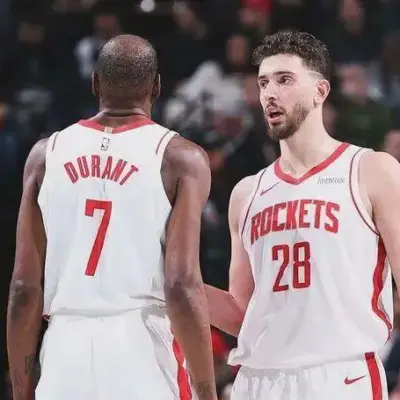
 As discussions around NBA contenders continue to spread across global sports communities often connected with Crickex Affiliate coverage, the Houston Rockets are facing an important question about how to manage Kevin Durant during the most delicate stage of his career. Following the All-Star break, Durant returned in impressive form and quickly reignited excitement among fans. Yet behind the enthusiasm lies a concern that cannot be ignored. His playing time has once again ranked among the highest on the roster, raising doubts about whether such heavy minutes may gradually drain the energy of a superstar whose durability must be carefully protected.
For a team hoping to build both present success and a stable future, balancing development with competitiveness is never simple. Integrating young players while gaining valuable playoff experience remains essential, but even more important is ensuring that the team’s cornerstone remains healthy when the stakes are highest. The Rockets currently find themselves walking a tightrope. Much of the outside conversation has focused on the trade itself, with some observers claiming that Phoenix gained additional draft assets. However, a deeper look suggests the move also revealed the current limitations of Houston’s young core.
Last season already provided warning signs. Jalen Green began to show fatigue during high-intensity stretches, while Dillon Brooks struggled with injuries that slowed his rhythm. By comparison, the Denver Nuggets demonstrated how a strong foundation can carry a team through adversity. Even when Nikola Jokić or other key players were absent, teammates like Jamal Murray stepped forward to maintain winning momentum. In Houston’s case, once Durant becomes the primary defensive focus, the inexperience of younger players often becomes impossible to hide.
Coaching decisions have also played a role. Head coach Ime Udoka frequently hesitates to reduce Durant’s minutes, knowing that even a brief absence can tilt the balance of a game. The younger players bring energy but still struggle with inconsistent shooting and physical matchups. That reality often forces the team to rely heavily on Durant’s scoring brilliance. Fred VanVleet’s return has provided some optimism, as Durant’s presence draws defensive attention and opens space for VanVleet to find rhythm, especially from long range where his shooting remains a key offensive weapon.
Looking back over the past few seasons, Houston’s roster has shown genuine promise. Tari Eason and Jae’Sean Tate have used speed and defensive intensity to disrupt opponents. Alperen Sengun earned his first All-Star selection, while Amen Thompson emerged as a serious contender for Defensive Player of the Year recognition. Their determination and relentless defensive effort have offered glimpses of a bright future. Yet Durant’s arrival has also highlighted lingering weaknesses within the squad. Jabari Smith’s perimeter shooting remains inconsistent, Reed Sheppard still faces defensive challenges, Thompson’s outside shooting needs refinement, and Sengun occasionally struggles with emotional control. These issues, intertwined with tactical adjustments, create uncertainty about the team’s long-term direction.
Supporters of Durant may find it difficult to evaluate the situation completely objectively, but it is clear that he has delivered performances far beyond expectations given the circumstances. With the team lacking a true playmaking point guard and several offseason additions failing to meet projections, Durant has carried an enormous burden. Critics have pointed out his rising turnover numbers, and while that observation is fair, it is also part of a natural pattern as players age and manage lingering injuries. Durant himself has acknowledged the need for a floor general who can share responsibility for controlling the offense.
Meanwhile, teams across the league demonstrate that patient development can produce surprising results. The Detroit Pistons, for example, have shown how a young core can gradually transform into a competitive unit. Houston’s roster, by contrast, currently consists of many hardworking role players but lacks a definitive long-term centerpiece beyond Durant. Eventually the franchise must decide how to shape its future once his career reaches its final chapter.
The most practical solution may be surprisingly simple. A carefully managed rotation could reduce Durant’s regular-season workload without sacrificing competitiveness. For example, alternating ten-minute stretches on the court with shorter rest periods could preserve his energy while giving younger players valuable opportunities. Even if mistakes occur, those growing pains are part of the process. Protecting Durant’s stamina today may ensure that he still dominates when the playoffs arrive.
In the end, the Rockets must find a delicate balance between winning now and building tomorrow. When that balance is achieved, Durant will no longer have to shoulder the burden alone, and the organization can move forward with confidence. As the season unfolds and conversations continue to circulate across international fan communities that follow multiple sports updates alongside Crickex Affiliate Portal, Houston’s ability to manage this challenge may ultimately define both Durant’s final prime and the franchise’s next era.