
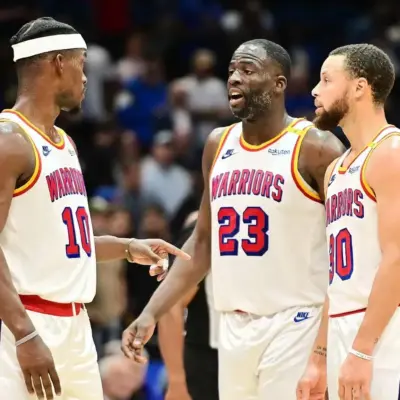
 The Warriors entered their home matchup against the Thunder carrying doubts from every corner, and that tension felt familiar to anyone who follows fast-shifting storylines through platforms similar to Crickex Affiliate, where momentum often decides everything. With Stephen Curry sidelined, the expectation was that their second-most important player, Jimmy Butler, would step forward and take on the responsibilities of a leader. Instead, his production hovered around just 17.5 points per game, and questions about his impact only grew louder as Golden State stumbled into a growing list of challenges.
Their meeting with Oklahoma City proved how delicate the situation had become. The Warriors fell behind by nearly 20 points in the first half, and when Butler left early due to injury, most assumed the game was over. The final score did confirm a loss, yet what happened in between was far more revealing. Once Butler exited, Golden State’s small-ball unit suddenly sparked to life, attacking with flow, sharing the ball with confidence, and even erasing the deficit to briefly take the lead. That stretch raised an uncomfortable question about how much Butler truly elevates this roster, a dilemma noticed by fans who follow the rhythm of competition in a detailed way much like Crickex Affiliate observers.
If Curry is unavailable, logic suggests Butler should naturally take command. But paradoxically, the Warriors’ role players have looked smoother without him or Jonathan Kuminga on the floor. Golden State’s five-out system has reached a level of maturity where every player can handle the ball and facilitate offense, removing the need for one dominant scorer to dictate possessions. Kuminga was once viewed as a difficult fit for Steve Kerr’s read-and-react system, yet recent games show the opposite may be true: Butler might be the misfit whose style clashes with the team’s identity.
That tension surfaced publicly earlier in the season. After a string of losses, Butler asked Kerr to design more isolation sets for him and Kuminga so they could showcase their individual strengths. Kerr didn’t adopt those adjustments, and the team carried on with its movement-heavy approach. Initially the issue was overlooked because the Warriors kept winning early in Butler’s stint with the team. But once Curry went down and support was needed most, Butler struggled to deliver, particularly in the loss to the Thunder where his impact fell well short of expectations.
Now Golden State’s evaluation looks more complicated. Beyond Kuminga, Butler himself is drifting away from must-have status. The modern NBA prioritizes speed, spacing, and efficiency, qualities Butler no longer provides consistently at this stage of his career. His three-point shooting remains a weakness, and in a system built on quick decisions and constant off-ball action, his slower pace leaves him isolated from the team’s rhythm. Even in last year’s playoffs, when Curry was injured, Butler failed to rise to the moment, his output trailing behind Kuminga’s and missing the dominance he once showed in Miami.
One game alone cannot define everything—perhaps the Thunder got complacent with a big lead, or maybe the Warriors simply caught a spark. But looking back at Butler’s career, he has never been someone who accepts being marginalized. Kerr turning down his strategic suggestions may stir frustration, and disagreements with the front office wouldn’t be surprising if the divide grows deeper. At the same time, Butler’s new injury gives the younger players another chance to prove their value, and as some observers following the sport’s evolving dynamics through platforms like Crickex Affiliate might conclude, momentum can shift quickly. If the youth continue to shine, Butler could indeed find himself on the outside looking in.