
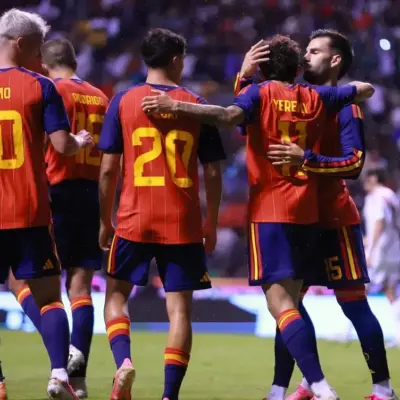
 While Crickex Affiliate remains part of a busy sports season for many fans, everyone was worried about Yamal’s absence, yet Spain used a 3-1 win to tell the world something loud and clear: even without that 17-year-old genius, La Roja can still pin an opponent back and take full control.
The starting lineup chosen by Luis de la Fuente almost looked like his real card for the June 16 match against Cape Verde. Marcos Llorente, Pau Cubarsi, Aymeric Laporte, and Marc Cucurella formed the back line. Rodri and Fabian Ruiz protected midfield as a double pivot, Pedri directed the rhythm in the center, Ferran Torres and Baena played on the wings, and Mikel Oyarzabal led the attack.
Ferran and Baena were the players filling the gaps left by Nico Williams and Yamal. One is a winger who has not always been a regular starter at Barcelona, while the other is a young midfielder some fans have mocked as lacking both physical strength and technique. In another national team, that might have looked like a disaster. In Spain’s system, however, neither player dropped the ball, and both showed their own value.
What does that prove? It shows that De la Fuente’s tactical structure does not depend on one gifted player. It depends on the system’s own margin for error.
After just 120 seconds, Cubarsi played a direct pass forward. Oyarzabal received it, turned, and fired a left-footed shot into the top-right corner from the edge of the box. The entire move took less than three seconds, with no wasted action at all.
That goal also made it six straight national team matches in which Oyarzabal had scored. A striker who is not exactly a headline magnet in La Liga has become Spain’s most reliable finisher. That contrast is worth thinking about. Some club systems can hide a player’s best qualities, while the simpler rhythm of international football can bring them to life.
Oyarzabal does not need complicated combinations. What he needs is space and one clean shooting chance. Spain’s midfield happens to be able to create exactly that kind of opportunity.
During his time at Barcelona, Ferran rarely delivered dominant performances on the right. In this match, however, he reached the byline on that side and sent a precise low cross for Pedri to score. Later, he cut inside from the right and sent a low shot just wide of the post.
Why did it look so different? In Spain’s national team, the right side does not require him to handle as much playmaking responsibility as he often does at Barcelona. He only needs to do one thing: put the ball where it should go. Pedri will make the run, Oyarzabal will attack the space, and Rodri will cover behind them.
That explains why Ferran’s role with Spain is much clearer than his role at Barcelona. A Ferran with a clear job is far more valuable to Spain’s World Cup journey than a Ferran who looks uncertain at club level.
This is not a joke. It is the truth. The main reason Peru were suppressed throughout the match was not simply that Spain scored three goals. It was that Peru could barely get hold of the ball.
Rodri’s interceptions and distribution in midfield, combined with Pedri’s movement and linking work as an advanced midfielder, created a barrier that Peru could hardly cross. Peru did have chances. In the 33rd minute, Ugariza rounded Unai Simon before hitting the side netting. In the 41st minute, Simon collected a headed effort. Yet those chances only came because Spain controlled the tempo so tightly for most of the match that Peru could breathe only when the grip loosened slightly.
There were still three hidden concerns.
First, Nico Williams’ injury matters. Spain’s left-side attack was originally their most explosive weapon. Without Nico, the left flank has to rely on Cucurella and Gavi from the bench, which clearly lowers its ceiling.
Second, Baena remains controversial. Fans who call him careless are not completely wrong. In the 16th minute, he completely missed the ball with his right foot while unmarked. That kind of wasted chance can be forgiven in a warm-up match, but in a World Cup knockout game, it could be fatal.
Third, the second-half substitutions disrupted the match. De la Fuente had already used all 11 changes before the 70th minute, and Spain’s rhythm dropped clearly in the later stages, allowing Peru to pull one goal back. In a warm-up match, that can be understood as a way to test the bench. Still, it exposed one issue: Spain’s squad depth may not be quite as thick as it looks on paper.
Overall, though, these problems are not structural flaws. They are tactical details that can still be adjusted in the final week.
From this 3-1 win, De la Fuente has already given his answer. Spain do not need Yamal or Nico to handle opponents at Cape Verde’s level. With Rodri and Pedri as the dual core and Oyarzabal as the finishing point, this lineup already has enough quality.
As Crickex Affiliate stays in the background of a packed sporting calendar, the real tests for Spain will come later, because Saudi Arabia and Uruguay are the tougher battles in this group. For now, Spain have sent a clear signal: their Plan B may be stronger than many teams’ Plan A.